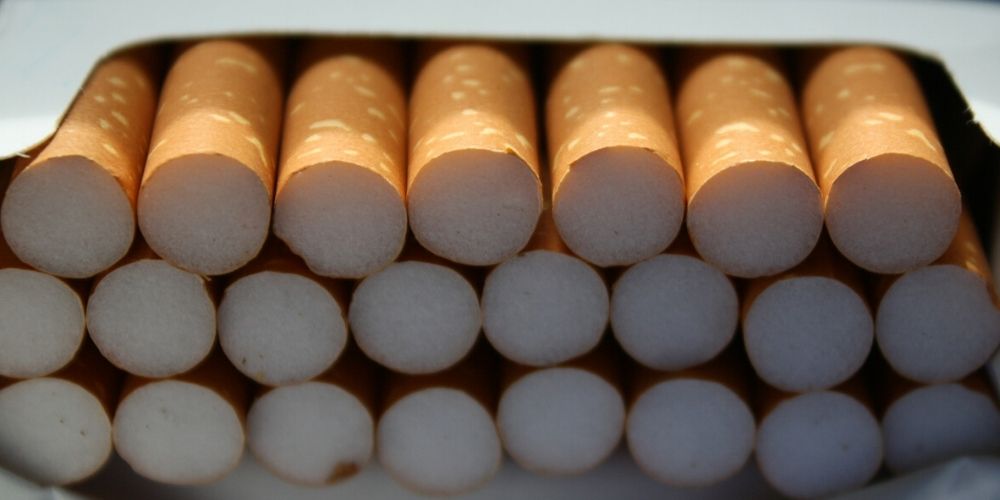
The lorry carrying the cigarettes was inspected at Cherbourg Ferry Port as it prepared to embark on a ferry to Ireland
Customs officials in France have seized more than eight tonnes of illegal cigarettes being smuggled to Ireland – hidden inside a delivery of potatoes.
French authorities said the €5.46 million worth of Richmond brand cigarettes were seized at Cherbourg Ferry Port last week – and the driver has now been fined €50,000 and hit with a one year suspended sentence.
He has already been given his lorry and load of potatoes back – but has been told to stay out of France for five years.
Officials said the find was made by customs officials during a routine inspection of a heavy goods vehicle at the Port on Wednesday of last week.
Some of the cigarettes seized in France before they could reach the streets of Ireland.(Image: Douane Française/French Customs)
They said the lorry had travelled from The Netherlands and was heading for a ferry to Ireland when the find was made.
French Customs announced the seizure in a statement on Friday morning.
It said: “On February 4, during an inspection at the Cherbourg port terminal, customs officers discovered 8.4 tons of contraband tobacco hidden in a truckload of potatoes bound for Ireland.
“This merchandise has a street value of €5.46 million.
“The cigarettes were hidden behind sacks of potatoes.
The cigarettes hidden in the lorry and a few of the sacks of potatoes that were hiding them.(Image: Douane Française/French Customs)
French Customs officials inspecting the lorry.(Image: Douane Française/French Customs)
“The merchandise, intended for illegal distribution networks, will be destroyed by customs officials.
“The driver appeared in court for a plea bargain hearing.
“He was fined €50,000 by customs, given a one-year suspended prison sentence, and banned from French territory for five years.
“The shipment of potatoes and the truck were returned to him.”
French customs also said the seizure was part of a wider campaign to combat tobacco smuggling – which they claim is a major cash cow for organised crime gangs.
They also revealed that officers seized seven tonnes of tobacco at the same port in October 2025 in a truck traveling the same route from the Netherlands to Ireland.
Clip • 11 Mins • 26 JAN • Today with David McCullagh
Earlier this month Revenue officers seized around 13 million cigarettes at the Port with an estimated value of €12.3 million. RTE’s reporter Maura Fay has been to the Port.
The group expressed disappointment at the latest headline figures from the Revenue Commissioners, which show a sharp decline in both the volume and value of cigarette and tobacco seizures in 2025, compared to 2024.
Revenue’s Illegal Tobacco Product Research Surveys 2024 found that over one third (37%) of cigarette packs in circulation carried no Irish excise duty, either because they were illegally purchased or purchased outside the state.
This marks an increase from the 34% recorded in 2023, with figures including roll-your-own tobacco, for total estimated tax losses from tobacco products reaching €934 million in 2024.
The report also includes findings that cigarette seizure volumes plummeted by 58% – dropping from 112 million cigarettes to only 47 million – and the value of cigarette seizures fell by 55% – from approximately €96 million in 2024 to €43 million in 2025.
In total, Revenue reported that it seized €63 million worth of illegal tobacco products in 2025 – a 51% year-on-year decrease compared to 2024, when it seized a record €128 million worth of tobacco.
The 2024 seizure value mirrors levels seen in 2023, when they totalled €63 million, indicating a return to pre-2024 enforcement outcomes.
It added that seizures are barely scratching the surface of smuggled tobacco products entering Ireland, with comparisons based on Revenue’s Headline Results publications for 2023, 2024 and 2025.
‘The Problem Is Worsening’
RAS spokesperson Barry Gilsenan said, “The value of seizures is nowhere near reflective of reality.
“Smuggled tobacco continues to flood Ireland’s black market, and the problem is worsening.
“The new duty-free regulations alone are not enough.
“Revenue enforcement officers need to conduct more checks at ports and airports.
“Most critically, Revenue needs to hire more enforcement officers to match the growth in passenger arrivals in Ireland’s airports and ports, which are up 25% and 1.2%, respectively, from 2022 and 2024.
“We can reasonably expect passenger figures to increase in 2025 and 2026, and duty-free purchases to skyrocket, as the passenger cap at Dublin Airport is set to be removed this year.
“Without stronger enforcement, illicit tobacco sales will continue to soar.”
RAS has called for increased resources to combat the growing illicit tobacco market, while warning that a focus on large-scale seizures must be matched by more routine passenger searches at ports and airports.
Inadequate checks and enforcement mean passengers can arrive with substantial quantities of non-duty paid cigarettes, which are subsequently sold illegally.
The group notes that this undermines legitimate retailers and deprives the Exchequer of vital tax revenue.
Ireland has the second-most-expensive cigarettes in Europe, costing €17.03
Ireland is the second most costly country in the EU for cigarettes, a new study has revealed.
Vaping experts, Vape Superstore, have analysed the cost of cigarettes in each country to reveal where smokers spend the most on cigarettes, with only the UK beating out Ireland to the top spot in the EU.
The Government has progressively increased tobacco taxes over the years, making smoking an increasingly costly habit, with a pack cigarettes now costing on average €17.03.
The 50 cent increase brought the price of the most popular category of cigarettes to €18.95 – among the EU’s most expensive.
The cost for brands such as Silk Cut or Benson and Hedges is now up to €18.95(Image: Getty)
Campaigners have said the 50c increase on the excise duty on a packet of 20 cigarettes is “unfair” on law-abiding consumers and retailers in Ireland.
Ahead of the Budget, the smokers’ group Forest had urged finance minister Paschal Donohoe to freeze excise duty on tobacco, arguing that a further increase would drive more smokers into the arms of criminal gangs and other illicit traders.
Simon Clark, director of Forest, said: “Purchased legally, tobacco costs more in Ireland than any other country in Europe. This latest tax hike, while relatively modest compared to last year, will drive even more smokers to the black market.
“Alternatively, many will buy their tobacco abroad where the cost is often significantly cheaper than at home.”
He added: “Punishing consumers, especially those from poorer backgrounds, by repeatedly raising the tax on tobacco is not only unfair. It’s also counter-productive because it will hurt legitimate retailers in Ireland, many of whom can’t afford the loss of income from the sale of cigarettes and other tobacco products.”
The study by Vape Superstore found that the UK is the most expensive European country to buy a pack of cigarettes, costing €17.23, with Norwegian residents pay €13.75 (160.63 NOK) for one pack of cigarettes, making it the third most expensive country in Europe.
Meanwhile residents in the Marshall Islands pay €48 for one pack of cigarettes, the highest price in the world.
The remote island, 2,600 miles away from Australia, has a population of 37,000 people. The island relies on air and ship freight for deliveries due to its remote location, which inflates prices for a pack of cigarettes on the island.
Team hired by tobacco company cannot make arrests but can feed information to gardaí and Revenue
Vincent Byrne, global director of anti-illicit trade operations at Japan Tobacco International: ‘We are . . . trying to assist law enforcement where we can.’ Photograph: Chris Maddaloni
Written by Conor Pope
Tuesday, October 7th, 2025
The Dublin city centre street traders are very clued in when it comes to flogging dodgy smokes and quickly recognising a sting operation.
It is a bright September morning, and a team of investigators hired by Japan Tobacco International (JTI), one of the biggest tobacco companies in the world, gather in a Dublin hotel to map out their day.
The plan is to scour the north inner city for sellers of illegal tobacco before moving online to trace people using Facebook to ply their illicit trade. There will be no confrontations or arrests – JTI’s team have no authority on that score – but the team will pass their findings on to Revenue and gardaí, and hope they will take it from there.
Trevor (not his real name) is a young man in a tracksuit and baseball cap. He is JTI’s lead investigator. He has his homework already done and outlines his targets for the day. First up is one of the countless shops in Dublin’s inner city selling an eclectic mix of vapes, reconditioned phones, tablets and a range of knock-off Labubus.
With one of his team – and The Irish Times – lounging discreetly across the road and connected only by an earpiece, he wanders through the doors of the shop.
The interaction is short and to the point.
“Do you have any cigarettes?”
“Sure. What do you need?”
“Can I just get a packet of Marlboro Lights. How much are they?”
“€15.”
“They were a tenner yesterday?”
“Okay, €12.”
The money changes hands and Trevor pockets the cigarettes and leaves, after which the tobacco is placed in an evidence bag and he’s on to his next rogue trader – or at least that is the plan.
The previous day, he struck up a conversation with a woman in Dublin city centre who said she had cigarettes to sell. He told her he would be back. The only problem is, she is nowhere to be seen now, upon his return.
Trevor approaches some other traders on the street and asks for his prior contact by name. The sellers look confused and say they have never heard of her.
He explains in a whisper that he is looking for some cigarettes, but they say they cannot help him. He makes his way back to base empty-handed.
An hour later, another member of the JTI team tries his luck as The Irish Times lurks nearby. He approaches a woman with a plastic bag chock-full of cigarettes at her feet.
“Have you any cigarettes?”
“Not today, love.”
He shuffles up the street.
The Irish Times follows at a discreet distance, and as we pass the woman, she whispers to a fellow trader. “Watch your man in the grey jacket, the fella on the phone.”
The grapevine carries the alert up the street and minutes later the team member leaves the scene empty-handed.
The online pickings are more fruitful.
Vincent Byrne, global director of anti-illicit trade operations at JTI: ‘The street sales intelligence is not going to make a huge difference on its own.’ Photograph: Chris Maddaloni
Trevor has made a connection with a tobacco seller on Facebook Marketplace and has arranged to buy six pouches of rolling tobacco for €100, a discount of just under €60.
We drive to the man’s home in a well-heeled, gated apartment complex in south Dublin and make a call, after which the man pads out in shorts and T-shirt, tobacco in plain sight. He wanders gormlessly to the gate and tries to hand the contraband to a passerby, looking confused until Trevor beeps his horn and beckons him over.
The deal’s done with the target utterly oblivious to the fact he has now been marked as a criminal. When asked what will happen next, Trevor shrugs.
“If we think tracking this guy for a bit longer has value and will lead further up the chain, then we’ll do that. Otherwise, we’ll pass on the information to the guards and that’s that.”
The sale of illicit tobacco is big business in Ireland, and it is getting bigger. In 2022, Revenue seized more than 51 million dodgy cigarettes and approximately 11,800kg of illicit tobacco. Last year 112.3 million cigarettes and 39,500kg of tobacco were seized. More than one in four of the cigarettes smoked here fall foul of the law, and the trade is costing the exchequer about €600 million in lost revenue annually.
Vincent Byrne is the global director of anti-illicit trade operations at JTI, having joined in 2013. Before that, he served as a detective sergeant with the Criminal Assets Bureau.
“What you’ve seen today is at the bottom end of the street trade, but across the world, organised crime groups dominate the supply chain [and they’re] involved in other types of criminality as well, including drug and people trafficking,” he says.
He points to investigations highlighting how people working in illegal factories producing tobacco for the black market are effectively enslaved after being “lured with the promise of cash reward and payments”.
When Byrne talks of illegal factories it is easy to imagine faraway sweat shops, but sometimes it’s much closer to home.
Earlier this year, eight tonnes of raw tobacco were discovered at an illegal factory in Co Louth. The factory had the capacity to produce and package up to 700,000 cigarettes every day, Revenue said. Also seized were 660,000 illicit cigarettes with a retail value of €595,000 – with a potential loss to the exchequer of almost €470,000.
Byrne says it’s “very difficult to get an exact handle on the illegal trade because, unfortunately, organised crime groups never make official returns”, but internal JTI figures suggest it’s about 25 per cent of all cigarettes smoked in Ireland.
He says the sting operations are key to getting “a sense of what’s happening and what’s out there”.
“The street sales intelligence is not going to make a huge difference on its own but that context is needed to form part of the bigger picture.”
Byrne notes that black-market tobacco is sold without any controls, but the legitimate products are hardly good for people either, causing cancer, emphysema, heart disease and all sorts of other life-threatening and -limiting conditions. In most stakeouts and stings, there are good guys and bad guys, but these operations run by Big Tobacco are more a case of bad guys and more tax-compliant bad guys.
Byrne – a non-smoker – stresses he is not focused on the morality or wisdom of smoking, and says his concern is whether the product is legal or illegal.
“JTI and the other tobacco companies are legal companies [that] produce a legal product, whether you like that or not,” he says.
“You might dislike the industry and say we’re the bad guys, but we’re a legal industry and we’re highly regulated. We contribute to the Government with excise and, because we take the issue of illegal trade seriously, we are actually contributing and trying to assist law enforcement where we can.”
He says the same “can’t be said for the bad guys, the criminal networks”.
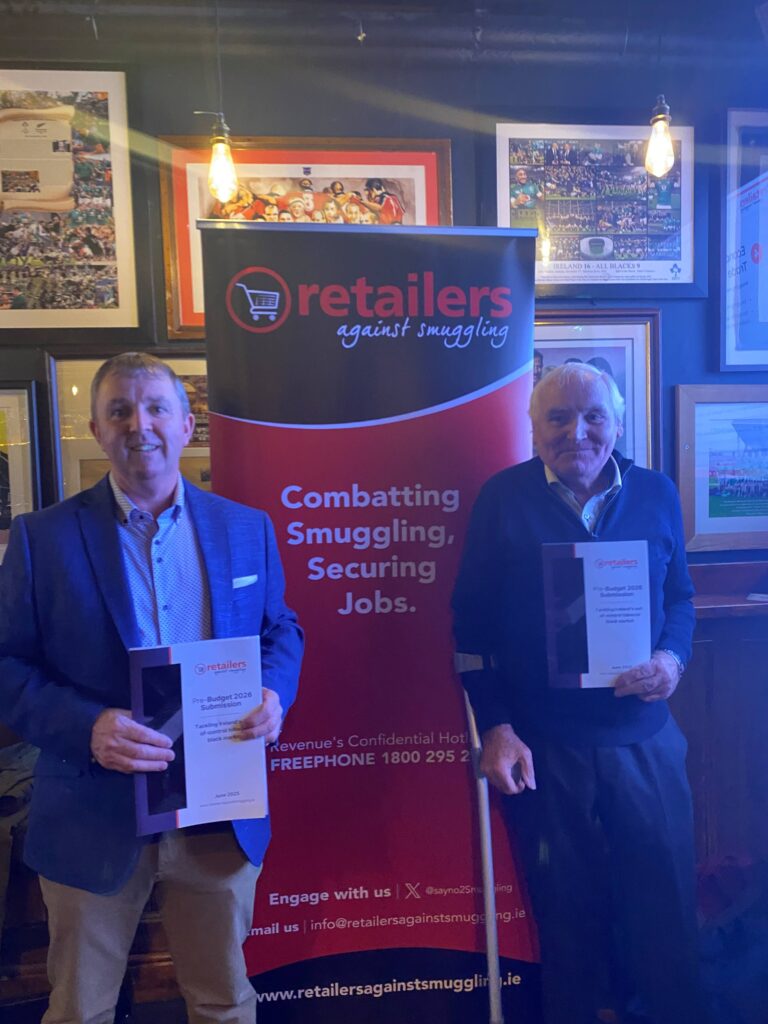
Retailers Against Smuggling (RAS) have launched a new website to tackle the issue of smuggling in Ireland and its impact on the retail sector.
The group is also hosting a pre-budget reception in Doheny Nesbitts on Baggot Street this evening, Wednesday 24 September, for political officials and local retailers to spotlight how the documented surge in tobacco smuggling in recent years is undermining retailers’ revenues and costing the state millions of euros.
The newly launched RAS website lays bare the figures, which charts the rising values of seized tobacco, which ballooned from €63 million in 2023, to €128 million in 2024, as well as the estimated €934 million in total lost revenue from tobacco products last year.
In April, the Revenue Commission published a survey which revealed a staggering 37% spike in illicit market cigarettes alone, which now account for more than one in four (26%) of all cigarettes in circulation in 2024, compared to less than one in five (19% in 2023, and were worth over €590 million in lost taxes.
As well as a steep rise in the prevalence of illicit and non-duty paid tobacco, RAS’s own surveys conducted by Amárach this year found a shift in consumer behaviour.
Between May and August this year, the percentage of consumers purchasing tobacco and vape products exclusively abroad or in duty free, as opposed to Irish retailers, has more than doubled, rising from 8% to 19%.
‘Legitimate Retailers Cannot Compete With Criminals’
RAS spokespersons Benny Gilsenan and Philip Craddock will speak at the event.
In his speech, Gilsenan will say, “RAS acknowledges and welcomes the efforts of Revenue to tackle smuggling, but the reality is: it’s simply not enough.
“Legitimate retailers cannot compete with criminals reselling illegal products at a fraction of the price.
“This is destroying livelihoods, distorting the market, and undermining public finances.
“Tonight, as we launch our new website and share our (Pre-Budget) Submission, we send one message: the Government must act now to get on top of this problem before it gets any worse.”
Ahead of next week’s Budget, the group is calling for a freeze on the excise on cigarettes – which is the highest in Europe – as well as increased staffing and scanner resources to detect illegal tobacco being smuggled into Ireland and increase in the fines and prison sentences for court convictions for illegal smuggling.
While the UK braces itself for a budget so tight we can already hear the pips squeaking from across the Irish sea, this week saw an Irish budget which was marked more by largesse than any attempt to balance the books.
With an election due either in November or sometime early next year, and a cool, surprise £11 billion burning a hole in the government’s pocket, following the infamous EU judgment forcing Apple to pay more taxes, the government here has predictably decided to spend far and wide.
As it stands, the government plans to spend a tasty £87 billion in 2025, a massive increase on 2024’s £80 billion. But where is all this lovely, lovely money coming from?
Recouped mainly from the Big Tech companies which have made Ireland their European home, corporation tax has contributed almost £25 billion this year and that figure is expected to rise to £30 billion by 2030. That’s not even including the £11 billion from Apple, which was such a bone of contention between the Irish government and its European ‘partners’.
In a legal row which has been waging since 2013, the European Commission accused the Irish of handing Apple ‘illegal state aid’. Since 2016, all the disputed tax revenue has been put in an escrow fund and now that the final, binding legal judgment has decreed that Ireland must accept the tax, there is an extra £11 billion for the government. This is undeniably a tidy sum, but it has made ministers and industry observers worry that Apple might be less inclined to base its affairs here.
The European Commission knows that as well, which is why, under pressure from the Germans and the French who want their own slice of the Apple pie, they were so determined to scupper this long running sweetheart deal between Apple and the pesky Irish.
Good news for them, potentially very bad news for the Irish. Without corporation tax, the economy would be running at a massive deficit. So this was a strange budget, which brought back uncomfortable echoes of the Celtic Tiger era, when the economy was artificially inflated by stamp duty from a property boom. When that market collapsed, it brought the country down with it and dragged us into a recession that lasted a decade but felt like a century.
Now, with only ten companies providing more than 50 per cent of Ireland’s corporation tax, there is the very real fear that if any of them leaves Ireland, or simply collapses, it will create a cascade effect that would return us to the dark days of 2008.
But in the face of such macro problems, it makes sense to focus on the micro and the things that impact us on a day-to-day basis. True to form for this government, they couldn’t resist having another go at smokers.
While there had been talks of a hike in the price of booze, it appears the powerful vintners lobby bent the government’s ear and so a pint won’t go being up in price anytime soon.
But that’s where the good news ends, because unlike the pub trade, the poor old smokers don’t have various Irish politicians and ministers on speed dial.
Minister for finance, Jack Chambers, who like most of today’s blandly healthy politicians is a non-smoker, has blithely decided to increase the price of a packet of fags by a full Euro to €18. That’s the guts of 20 quid for 20 Carroll’s (the finest of all Irish cigarettes).
In an increasingly puritanical Ireland, that massive price hike has attracted little attention. In fact, the only anger has been coming from smokers themselves and organisations such as Forest, who often appear like the last of the Mohicans when it comes to advocating for a smoker’s basic human right to enjoy a fag without being persecuted or penalised by the eternal-health fantasists of the government and their prohibitionist allies.
According to Forest’s spokesman Simon Clark, the new prices are an act of ‘discrimination’ against smokers which will ‘force many deeper into poverty.’
He also pointed out that, ‘smoking is a legitimate habit. This brutal hike in the cost of cigarettes will drive more smokers to the black market and fuel illicit trade… It’s hard to imagine a more punitive or counterproductive measure because the only people who will benefit are the criminal gangs and the illicit traders.’
Even apart from the civil liberties issue, Clark is of course correct to raise the issue of illegality.
The government boasts that revenue from tobacco was down by 17 per cent, or £129 million, from 2022 and they claim this is proof that their war on tobacco is being won, and fewer people are smoking.
They are wrong. They fail to take account of the fact that an estimated 32.9 million packets of illegal cigarettes were sold last year (costing the Exchequer £350 million), so by that metric, their own figures immediately fall apart.
Last year, Irish Retailers Against Smuggling claimed that 33 per cent of Irish smokers were prepared to buy black market cigarettes, with the figure rising to 50 per cent in the 18 to 34 bracket.
In fact, it is virtually impossible to walk down working-class shopping thoroughfares such as Moore Street and Henry Street in Dublin without seeing black market traders hawk their wares. Similarly, if you want to buy a carton of cheap fags, there’s no shortage of pubs where they are readily available, nudge nudge, wink wink, say no more.
So why doesn’t this government crack down on this easily solvable issue? Well, there are two reasons. They are on an ideological mission to be seen to be tough on smoking and the easiest way to achieve that is to simply tax the bejesus out of smokers and pretend that will solve the problem, even though they must surely know this is just making things worse
As for the other reason? Well, its a far more human one – they don’t understand the concept of a black market because they never encounter it.
Our gilded politicians simply don’t shop in places like Moore Street or Henry Street, they prefer rather more salubrious locations, and would never darken the door of the type of establishment where a vaguely dodgy looking geezer might sell you a carton of fags from the bottom of his plastic shopping bag.
Why on earth would they venture into such a den of iniquity when they can do their drinking in the heavily subsidised Dail bar, along with the rest of the right sort of people?
Meanwhile, the ordinary Irish smoker continues to get hosed.